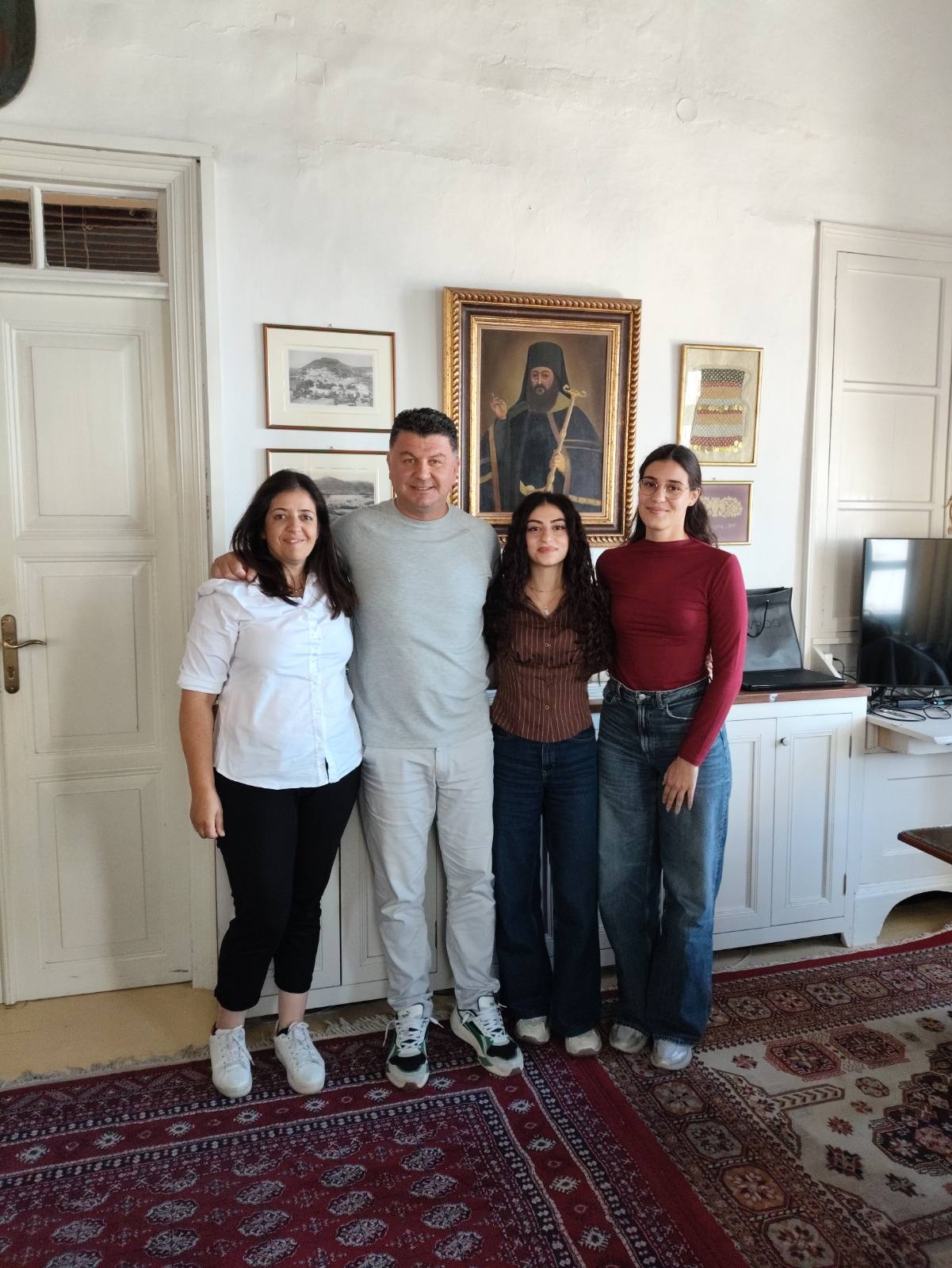
The Social Inclusion Observatory continues its field research in the Municipalities of the South Aegean for the 6th consecutive year, aiming to investigate social needs, local variations, common trends, and the potential for collaborative action against social challenges.
Within this framework, on Friday, October 2nd, 2026, researcher Ms. Eirini Tsopanoglou conducted interviews with the Mayor of Patmos, Mr. Nikitas Tsampalakis, the President of the Municipal Council, Ms. Argyro Giameou, Ms. Dimitra Paitaridi, President of the “Patmos Stadion” Gymnastics Club, and coach Mr. Charalamπος Angelakopoulos, as well as Ms. Maria Maravelia, President of the “Xanthos o Patmios” Sports Club. The discussions highlighted the impact of insularity on residents’ access to services and opportunities for social participation, with an emphasis on healthcare, transportation, the needs of children, youth, and the elderly, seasonality, and the staffing of local services.
 The Municipal Authority set as a core priority the improvement of the quality of life for children, youth, and families through interventions in schools and projects to upgrade sports facilities, spaces for creative activities, recreation, and green areas, which are currently at various stages of implementation. These interventions are linked to creating more opportunities for participation and strengthening the conditions that encourage young people to remain on the island.
Access to healthcare constitutes a particularly significant issue, as the difficulty in attracting and retaining medical staff limits the availability of core medical specialties. To address this problem, the creation of free housing units for doctors is being promoted, while the Municipality has established a financial incentive to attract them. Concurrently, the cost of travel and accommodation outside Patmos, ferry connections, and the necessity of accompanying children burden families and create inequalities in access to services and activities.
 Local clubs contribute to overcoming these limitations by offering children opportunities for socialization, creative engagement, and gaining new experiences. Wherever feasible, the “Patmos Stadion” Gymnastics Club combines sports travel with educational and cultural visits, and it has also covered the participation expenses of a child who would otherwise face financial barriers.
The Club’s initiatives include the Family Run, participation in “Be Active”, the annual road race, and the first Patmos Half Marathon in 2026. Collaborations with the Municipality of Patmos, the South Aegean Region, and SEGAS were mentioned for these events, while the 2026 organization took place under the auspices of the Greek National Tourism Organization (GNTO/EOT) and with the support of the General Secretariat for the Aegean and Island Policy.
The social and educational dimension of these initiatives is reinforced by collaboration with the Music School of Rhodes, school visits such as by author Nikos Michalopoulos, and the participation of the Kampos Cultural Association and the Chora Cultural Association. The contribution of the Red Cross of Rhodes was also important in providing medical coverage for the event due to limited local capacity. The half marathon mobilized a significant number of volunteers, while in 2026, the Club participated for the first time in five Panhellenic Championships, simultaneously promoting the values of respect, effort, cooperation, and participation.
Correspondingly, the “Xanthos o Patmios” Sports Club, through its football, basketball, and track and field academies, offers children stable opportunities for social contact and activity. The annual “3-on-3” tournament stands out, taking place in early July and hosting, according to the interview, approximately 120 athletes from other islands and regions of Greece for three to four days, enhancing networking, the creation of friendly bonds, and inter-island communication. The event is supported by the Municipality of Patmos, the South Aegean Region, sports organizations, and private individuals through covering specific needs. The two clubs highlighted common barriers to children’s equal participation: increased travel costs, weather conditions, the lack of suitable indoor facilities, and the absence of a cardiologist, which hinders the issuance of the necessary health cards. This highlights how deficiencies in healthcare and infrastructure can directly limit opportunities for social participation.
The elderly also constitute a significant priority, with the Municipal Authority pointing out the need to create a day care or support facility for senior citizens. The Municipality and the KEP (Citizens’ Service Center) assist residents facing difficulties with digital services, while during festive periods, sponsorships are sought to provide food supplies to people in need. Local associations and the voluntary blood donor team, which organizes blood drives twice a year, also contribute to social solidarity.
Broader daily challenges include water scarcity, to address which desalination interventions in Skala and Kampos were mentioned, alongside a water resource management plan. The seasonal increase in population intensifies the needs for water supply, sewage, and waste management. At the same time, understaffing, bureaucracy, and the limited technical capacity of the Municipality make staffing reinforcement, training, technical support, and inter-municipal collaborations essential.
Overall, the research in Patmos demonstrated that social inclusion on a small island is directly linked to access to healthcare, transportation, basic infrastructure, support for the elderly, and opportunities for children and youth to participate. The mobilization of the Municipality, clubs, volunteers, and collaborating bodies helps reduce inequalities, while simultaneously highlighting the need to strengthen stable public services so that geographical isolation does not pose a barrier to residents’ equal access to core goods and social opportunities.
We would like to warmly thank the Municipality of Patmos, the “Patmos Stadion” Gymnastics Club, and the “Xanthos o Patmios” Sports Club for their participation in the research, the time they dedicated, and their valuable cooperation in the work of the Regional Social Inclusion Observatory.
(Text & photos: Eirini Tsopanoglou)

 Αυτόματος έλεγχος προσβασιμότητας δικτυακού τόπου με βάση το πρότυπο WCAG 2.1 AA και με το εργαλείο “AChecker”
